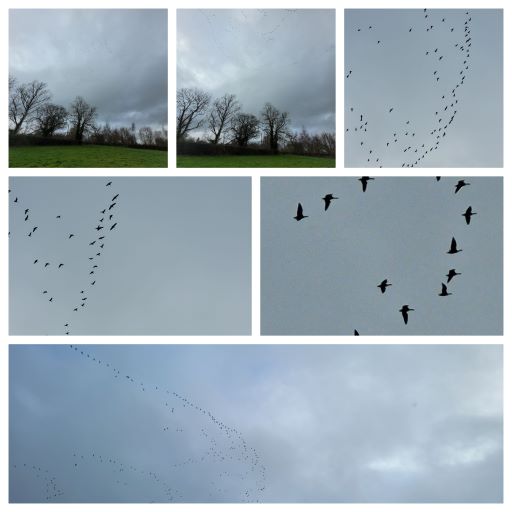
Enormous skeins of pink footed geese, often many hundreds in number, are now a common sight over our farm and across the winter skies of the Cheshire plain.
It was not always so – with historical records suggesting only occasional winter visits to Cheshire even as recently as the early 2000s. Their increased prevalence in Cheshire is reflected nationwide, with The Wildfowl and Wetlands Trust estimating UK wintering numbers at over 500,000, up from only ~50,000 in the 1960s. A real migratory bird success story.
These birds will shortly return to their summer breeding grounds in Iceland and Greenland (almost their entire pink foot population comes to the UK in autumn), having spent the winter commuting daily between night-time roosts on the Dee Estuary, and the open farmland of the Cheshire plain where they feed.
So far, the geese seem to have avoided our small, hedgerow-bounded fields, preferring the larger, more open fields across our Eastern boundary where they are undisturbed by roads and footpaths. No doubt many centuries of being shot at have taught them to stay well clear of man and the hedgerows and trees that could give cover to waiting hunters.
It is interesting to speculate why these birds have done so well.
Hunting pressure may have reduced somewhat, with perhaps fewer hardened wildfowlers prepared to wait in the desolate winter salt marshes at dawn for the chance of a passing goose, but I suspect that has little to do with it. Rather, I sense it may well be the very changes in British farming practices held responsible for recent declines in our traditional farmland birds (sowing winter wheat, intensive sugar beet production and improved grassland etc), that are now helping sustain ever increasing numbers of over-wintering pink feet. Perhaps they also benefit from ever-milder Arctic temperatures, increasing summer breeding success?
It’s a timely reminder that nature and conservation are rarely straightforward and that changes to the environment that are bad for one species may well create opportunities for another. Wood pigeons, buzzards, red kites and peregrine falcons provide other recent success stories – albeit each for their own reasons.
In any event, the chattering gaggles are a welcome part of our winter soundscape and remind us that, while it’s easy to believe it is all doom and gloom in the countryside, there are also good news stories to be found if you look up and and listen.
 Hope for the Lappinch
Leave a comment